
Living with a neuromuscular condition?
Muscular dystrophy, SMA, ALS, spinal cord injury, and cerebral palsy can weaken the muscles that power breathing and coughing. When a cough gets weak, mucus stays behind.

Why does mucus stay behind?
With neuromuscular conditions, the problem usually isn't the mucus — it's the cough.
A smaller breath in
Weak breathing muscles make it hard to take the deep breath a strong cough starts with.
A weaker push out
The muscles that drive a cough can't generate the airflow needed to move mucus up and out.
Mucus stays behind
Without an effective cough, mucus pools in the airways — and germs find it.
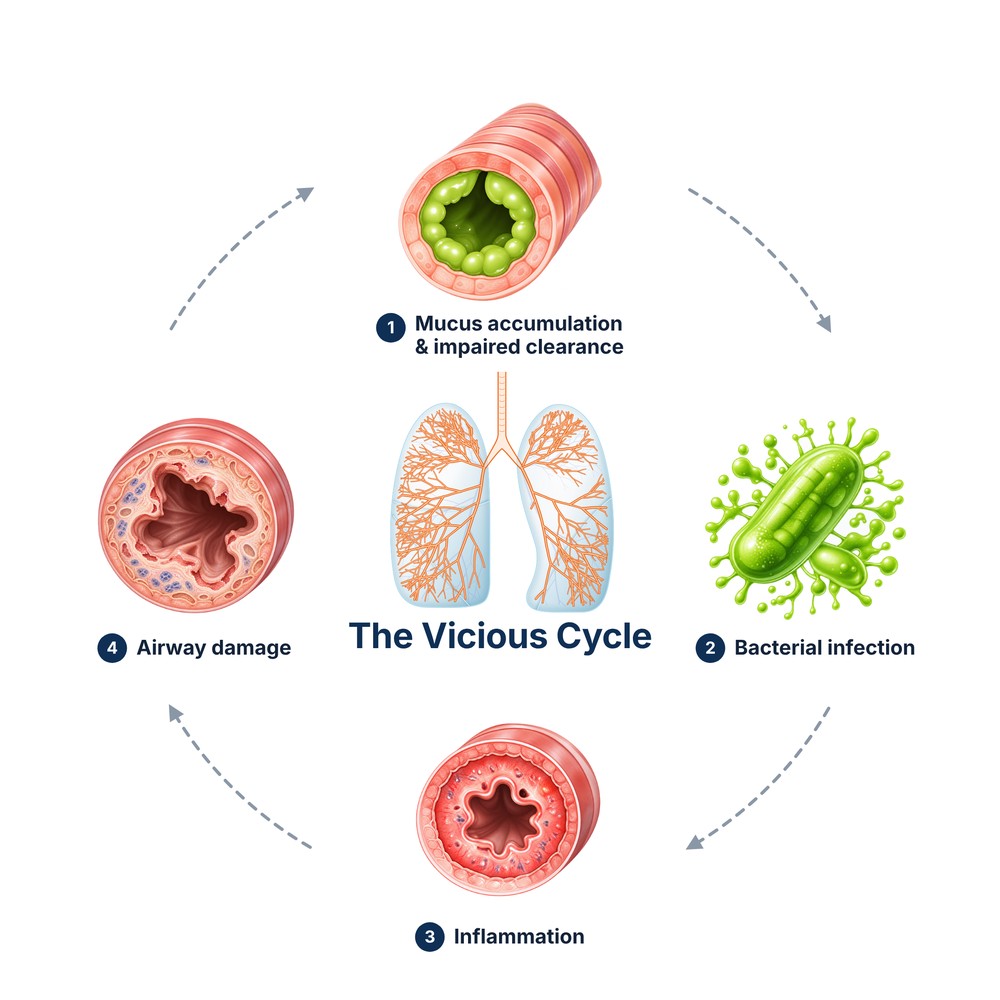
A weak cough opens the door to the same cycle.
With a neuromuscular condition, the cycle starts at a different point: the mucus itself may be normal, but the cough can't clear it. Once mucus is trapped, the consequences are the same as any other clearance problem — germs can grow more easily, which may lead to infection, inflammation, and further airway damage. The cycle continues.
The cycle can be interrupted. It starts with mobilizing and clearing the mucus — and supporting the cough that clears it.
Two jobs: move the mucus. Support the cough.
When the cough itself is weak, therapy has to do both — mobilize the mucus, and help generate the cough flow the muscles can't.
Mobilize the mucus
Airway clearance therapy helps move mucus toward the upper airways, where it can be cleared.
Support the cough
Assisted cough therapy (mechanical insufflation-exsufflation) helps generate the airflow a weak cough can't.
Stay consistent
Regular sessions help keep the cycle from rebuilding — your care team sets the routine that fits you.
There's more than one way to support clearance.
Some people do better with one approach, some with a combination. Your care team knows your picture, and they can help you decide.
Airway clearance (OLE)
Delivers oscillation internally via mouthpiece or mask — designed to create high-frequency oscillations with expiratory flow bias to help move mucus toward the upper airways.
Assisted cough (MIE)
Applies positive pressure to inflate the lungs, then rapidly shifts to negative pressure — designed to simulate a natural cough when the muscles can't produce one.
Manual techniques
Caregiver-assisted coughing and suctioning, often used alongside devices as part of a daily routine.
Bring these to your next appointment.
We can't answer these — your care team can. Screenshot this page and take it with you.
"Is my current airway clearance routine adequately managing my mucus burden?"
"Could assisted cough therapy be appropriate for my condition?"
"How would it fit into or replace parts of my current treatment routine?"
See how BiWaze® Cough works.
Stronger expiratory flow. Precision pressure control — designed around the physiology of the cough cycle.